
Design thinking, as a methodology, as a brand, as a curriculum, has had a remarkable run. Since IDEO popularized the framework in the 1990s and Stanford's d.school codified it into a teachable process, it has become the default language for human-centered innovation across industries, universities, and nonprofits worldwide.
And it has done real good. Empathy-first thinking, iterative prototyping, and reframing problems before jumping to solutions are all genuinely useful practices.
But there is something important that the framework rarely interrogates: whose worldview is doing the centering?
Every methodology encodes a worldview, and that worldview shapes what gets seen, what gets designed, and who benefits.
The hidden assumptions in "human-centered"
Human-centered design sounds universal. In practice, it tends to center a particular kind of human, one who is legible to research methods developed in Western academic and corporate contexts, one whose needs can be articulated in interviews and validated through usability testing, one whose relationship to the designed object or system is understood primarily as a user rather than a community member, a rights holder, or a person in relationship with land and ancestors.
This is not a criticism of individual practitioners. It is a structural observation. The tools, the timelines, the deliverables, and the metrics of success in conventional design thinking were built within a specific institutional context. They carry that context with them, even when deployed with the best intentions.
What indigenous frameworks offer instead
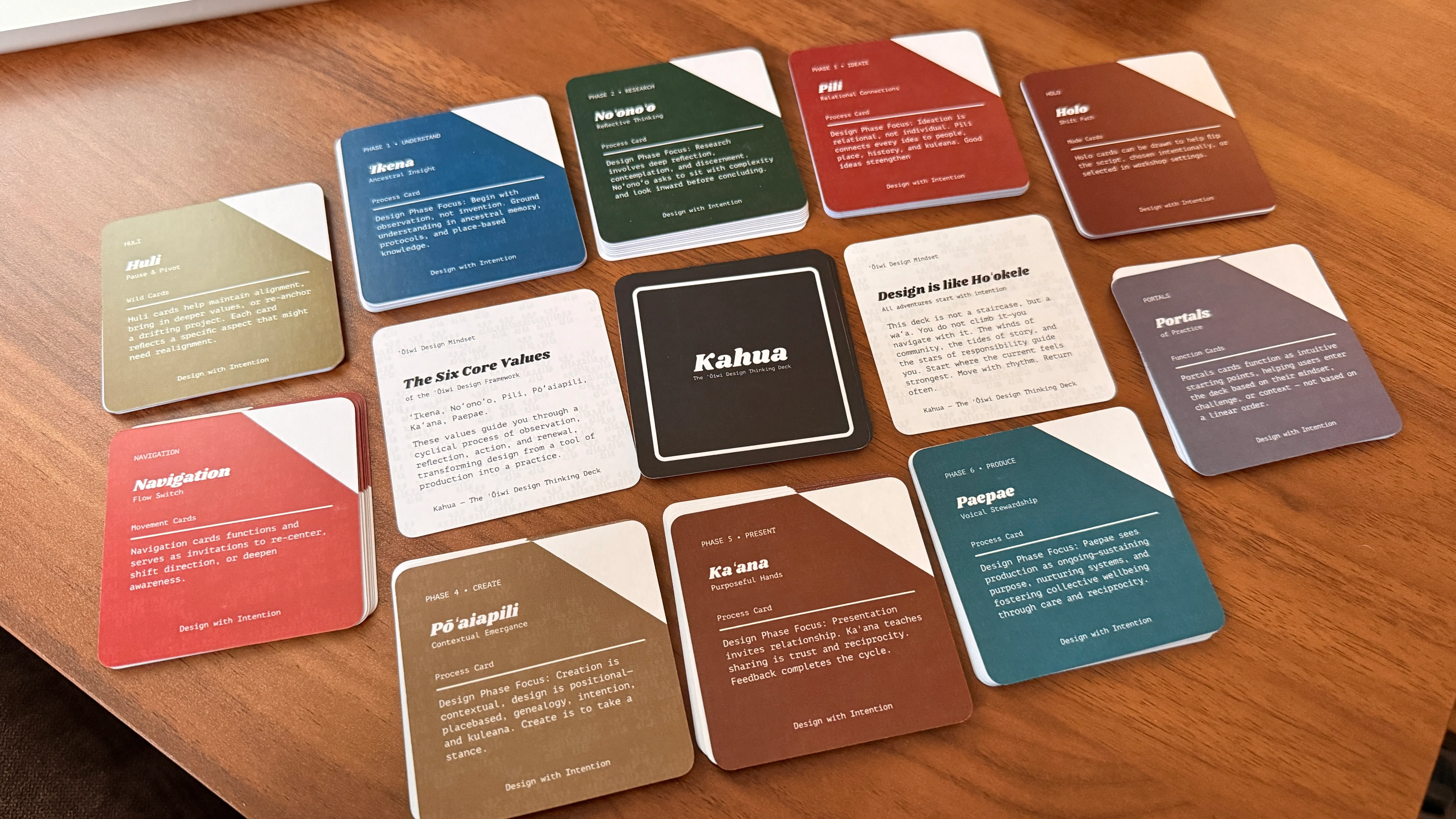
The ʻŌiwi Design Mindset, a framework developed to center Hawaiian practices of kilo, moʻolelo, and hana noʻeau as design methods, does not reject rigor. It redefines what rigor looks like.
Kilo, as sustained observation, asks designers to slow down and read context deeply before proposing anything. It is a research practice that values relationship and time over efficiency. Moʻolelo asks what story a design belongs to, not just what problem it solves, but what it carries forward and who it serves across generations. Hana noʻeau refuses the separation between thinking and making, between theory and practice.
These are not soft alternatives to design thinking. They are more demanding in some ways, because they require the designer to situate themselves, to know their own positionality, their own relationship to the communities and places involved, their own responsibilities as a maker.
The practical difference
In practice, this shift changes how projects begin. Instead of a design sprint, there is a period of listening. Instead of user personas assembled from interview data, there are relationships built over time. Instead of a problem statement generated by an outside team, there is a question that emerges from within the community.
None of this is incompatible with good visual design, good UX, or good communication. In fact, it tends to produce work that is more specific, more honest, and more durable, because it is actually rooted in the place and people it is made for.
A worldview, not just a method
The point is not that design thinking is wrong and indigenous frameworks are right. The point is that every methodology encodes a worldview, and that worldview shapes what gets seen, what gets designed, and who benefits.
Being explicit about that is not a critique to be defended against. It is the beginning of doing better work.